

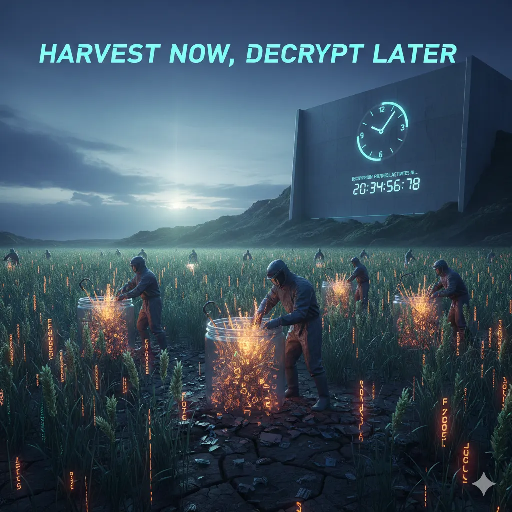
Why Quantum Computing makes today’s “secure” storage tomorrow’s open book.
The Threat You Can’t See
While security teams focus on today’s intrusion detection and real-time threat response, nation-state actors are executing a different strategy entirely. They’re not trying to decrypt your data today. They’re stealing it now and storing it in massive data centers, waiting for quantum computers powerful enough to crack current encryption standards.
This is called “Harvest Now, Decrypt Later” (HNDL), and it’s already happening.
The NSA confirmed this threat in 2022 when it urged federal agencies to begin transitioning to post-quantum cryptography. The Chinese Ministry of State Security has been systematically exfiltrating encrypted databases from Western corporations for over a decade. They’re not wasting resources trying to crack AES-256 encryption with today’s classical computers. They’re simply archiving the data and waiting.
The math is simple: If your encrypted data exists today, it will be readable tomorrow.
Why Traditional Encryption Has an Expiration Date
Every password manager, every encrypted cloud storage system, every “zero-knowledge” vault operates on the same assumption: RSA and AES encryption will remain computationally infeasible to break.
That assumption has a shelf life.
The Quantum Threat Timeline
- 2019: Google’s Sycamore processor achieved quantum supremacy for specific tasks
- 2023: IBM deployed a 1,121-qubit quantum computer
- 2025–2030: Experts predict cryptographically relevant quantum computers (CRQCs) capable of running Shor’s Algorithm at scale
- 2035: China has publicly stated its goal to achieve quantum decryption capability
Translation: Any encrypted data stolen today has a 10–15 year window before it becomes readable to adversaries with quantum capabilities.
For password managers storing encrypted vaults, this means:
- LastPass breach (2022): Stolen vaults will be crackable by 2032–2037
- Every backup ever made: Legacy data becomes a permanent liability
- Compliance nightmares: GDPR “right to be forgotten” becomes impossible when adversaries hold quantum-readable archives
Shor’s Algorithm: The Encryption Apocalypse
Current encryption relies on mathematical problems that are easy to create but hard to reverse:
RSA encryption: Factoring large prime numbers (2048-bit keys take classical computers millions of years)
Elliptic Curve Cryptography (ECC): Discrete logarithm problem (used in blockchain wallets)
Shor’s Algorithm, running on a sufficiently powerful quantum computer, reduces both problems from “millions of years” to hours or days.
What Gets Broken
- RSA-2048: Crackable with ~4,000 logical qubits
- ECC-256: Crackable with ~2,000 logical qubits
- AES-256: Resistant to quantum attacks (requires Grover’s Algorithm, which only provides quadratic speedup)
The fatal flaw: Most systems use RSA or ECC to exchange AES keys. Once the key exchange is broken, the AES encryption becomes irrelevant.
Password managers are especially vulnerable because:
- Master password derives encryption key (classical key derivation)
- Encrypted vault is stored persistently (static target)
- Attackers need only wait for quantum capability (no time pressure)
Zero-Persistence: The Only Quantum-Resistant Architecture
Here’s why Zero-Persistence defeats HNDL attacks:
1. No Persistent Keys to Harvest
Traditional systems store encrypted keys that can be stolen and archived:
[Encrypted Vault] + [Encrypted Master Key] = Future quantum target
Zero-persistence generates keys only when needed:
[User Passphrase] + [Blockchain State] → Ephemeral Key → Decrypt → Purge
There is no key to harvest. The attacker can steal the blockchain data, but without the passphrase (which exists only in the user’s memory) and the key derivation engine (the software itself), the data remains mathematically worthless — even with a quantum computer.
2. No Static Blob to Archive
HNDL attacks depend on stealing a complete, self-contained encrypted package:
- LastPass: Encrypted vault files stored on cloud servers
- 1Password: Encrypted vaults synced across devices
- Bitwarden: Encrypted JSON blobs in cloud databases
Zero-persistence systems store only:
- Encrypted credentials on blockchain (meaningless without ephemeral keys)
- Blockchain hashes (deterministic, non-reversible)
- No master key (not stored anywhere, generated on-demand)
What can an attacker harvest?
- Encrypted data: ✓ (Useless without key derivation)
- Blockchain ledger: ✓ (Public anyway)
- Decryption keys: ✗ (Never exist at rest)
- Key derivation parameters: ✗ (Embedded in client software, requires passphrase)
Even with a quantum computer capable of breaking RSA-2048 in seconds, the attacker has nothing to apply it to.
3. Mathematical Irrelevance to Future Threats
The genius of zero-persistence is that it doesn’t matter what future computers can do.
- Quantum computers can factor large primes? Irrelevant — we’re not using RSA key exchange.
- AI can brute-force key spaces? Irrelevant — there are no stored keys to brute-force.
- Post-quantum algorithms get broken in 2040? Irrelevant — our security doesn’t depend on algorithmic strength, it depends on the absence of persistent attack surfaces.
The Post-Quantum Migration Problem
The cybersecurity industry is currently scrambling to adopt NIST’s post-quantum cryptography standards (CRYSTALS-Kyber, CRYSTALS-Dilithium, SPHINCS+). This is a multi-billion-dollar, multi-year effort to replace every RSA and ECC implementation across the internet.
But here’s the problem: Post-quantum algorithms are still persistent encryption. They’re still storing keys. They’re still creating static targets.
They solve the quantum threat by making encryption harder. Zero-persistence solves it by making encryption irrelevant to attackers.
Migration Comparison
Traditional Password Manager (Post-Quantum Migration):
- Re-encrypt all vaults with post-quantum algorithms
- Migrate all stored keys to new format
- Hope the new algorithms remain secure for 20+ years
- Repeat migration when next threat emerges
- Still vulnerable to future HNDL attacks
Zero-Persistence System (No Migration Required):
- Continue generating ephemeral keys on-demand
- No stored keys to migrate
- No vaults to re-encrypt
- Quantum-resistant by architectural design
- Immune to future HNDL attacks
Why Nation-States Fear Zero-Persistence
Intelligence agencies depend on three capabilities:
- Mass surveillance (intercept encrypted traffic in real-time)
- Data retention (archive encrypted data for future decryption)
- Lawful intercept (compel service providers to decrypt on demand)
Zero-persistence breaks all three:
Mass surveillance: Encrypted blockchain data contains no actionable intelligence without the user’s passphrase.
Data retention: Archiving blockchain data is pointless — it will never become decryptable with future technology.
Lawful intercept: Service provider cannot decrypt user data (dual-key architecture means provider holds only one key; user holds the other).
This is why the NSA opposed strong end-to-end encryption for decades. This is why the EU’s “Chat Control” proposal seeks backdoors in encrypted messaging. Governments want data that can eventually be decrypted.
Zero-persistence makes that impossible.
The Strategic Advantage for Enterprises
For organizations handling sensitive data (law firms, healthcare providers, financial institutions, defense contractors), HNDL is an existential threat:
Scenario: A law firm’s encrypted client files are stolen in 2026. In 2036, a quantum-capable adversary decrypts them and leaks privileged attorney-client communications.
Legal exposure:
- GDPR violations (failed to protect personal data)
- Professional liability (breach of attorney-client privilege)
- Class action lawsuits (negligence in data protection)
- Total liability: Potentially billions
With zero-persistence:
- Stolen data remains encrypted indefinitely
- No quantum computer can reverse ephemeral key generation
- No regulatory breach notification required (encryption keys were never compromised)
- Liability: Zero
The Blockchain Advantage
Zero-persistence systems built on blockchain gain an additional quantum-resistant property: cryptographic hash functions.
Blockchain uses SHA-256 hashing, which is resistant to quantum attacks (Grover’s Algorithm provides only modest speedup). This means:
- Block validation remains secure (quantum computers cannot reverse SHA-256 hashes)
- Chain integrity is preserved (altering historical blocks requires breaking SHA-256)
- Decentralized verification continues (no single quantum computer can compromise the network)
Combined with ephemeral key generation, blockchain-based zero-persistence creates a defense-in-depth architecture that survives quantum threats:
- No RSA/ECC vulnerability (not using public-key cryptography for key exchange)
- No AES key compromise (keys generated on-demand, never stored)
- Quantum-resistant hashing (SHA-256 remains secure)
- Decentralized validation (no single point of quantum attack)
The Only Future-Proof Architecture
The cybersecurity industry has spent 30 years building increasingly complex encryption schemes, each claiming to be “unbreakable.” History has proven otherwise:
- DES (1977): Broken by 1997 (brute-force attacks)
- MD5 (1991): Broken by 2004 (collision attacks)
- SHA-1 (1995): Deprecated by 2017 (collision attacks)
- RSA-512 (1990s): Broken by 1999 (factorization advances)
The pattern is clear: Persistent encryption eventually gets broken.
Zero-persistence doesn’t try to build a stronger lock. It eliminates the safe.
No persistent keys. No static targets. No harvest-and-wait vulnerability.
The data you protect today remains protected in 2050, regardless of what computational advances occur.
That’s not marketing. That’s mathematics.