

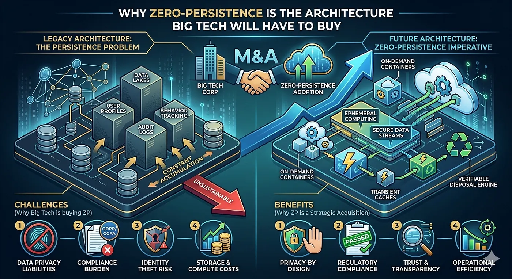
Let’s talk about something the industry doesn’t like to say out loud.
Microsoft can’t build this. Google can’t build this. Not from scratch. Not inside the infrastructure they’ve already got. Because the vault model isn’t just a product decision — it’s load-bearing. Pull it out and half their cloud architecture goes with it.
That’s not a criticism. It’s physics.
When you’ve got a hundred billion dollars of infrastructure optimized around persistent encrypted storage, you don’t retool. You acquire. You license. You pay someone who built the right thing from the ground up while you were busy patching the wrong one.
This is how it always goes. The incumbents don’t invent the next paradigm. They buy it when it’s too big to ignore and too embedded in the market to replicate cheaply.
Zero-persistence is that moment — not eventually, now. The breach headlines are getting worse. The cyber insurance premiums are climbing. The compliance burden is expanding. Every CISO in a regulated industry is sitting in a boardroom explaining why the vault they paid for leaked anyway.
The question they’re starting to ask isn’t “how do we fix the vault?” It’s “is there something that doesn’t have this problem by design?”
There is. It exists. It’s in production.
The organizations that evaluate it now — before the acquisition premium kicks in — are the ones who control the terms of adoption. The ones who wait get the price the acquirer sets.
That’s not a sales pitch. That’s just how markets work when one architecture makes another one structurally obsolete.